SBB XIII
The Lost SymbolSBB XIII is a concealed room in the United States Capitol’s subbasement, privately reserved for Peter Solomon and transformed into a Masonic Chamber of Reflection. Behind its death symbols and an apparently solid rear wall, Robert Langdon, Inoue Sato, and Trent Anderson discover an opening that reveals a stone pyramid. The room’s decisive significance lies in that double concealment: what first appears to be an abandoned storage chamber becomes a place of ritual reflection and the physical gateway to the mystery the searchers have been trying to reach.
Position and Access
SBB XIII lies in the Senate basement, in a subterranean stretch of the Capitol reached through the building’s old foundations. A handwritten notation in the records calls it private and says it was set aside for Peter Solomon. The designation came from the Architect of the Capitol, the official responsible for the building’s maintenance, security, personnel, and offices. The record helps explain why the space is not treated like an ordinary storage room, even though its location is buried among them.
The room’s designation becomes a puzzle before anyone reaches it. The SBB marking is on a door at the central point between the Senate Basement and the House Basement, and Trent Anderson initially assumes that the S stands for Senate. The passage’s storage rooms have been unused for years; paper records say that all but SBB XIII were cleaned out and abandoned more than two decades earlier. The remaining room is marked private, with the notation initialed by the Architect. Capitol security suspects Peter has the main key and the keys to the room, but no secondary key can be found. The space is therefore not simply hidden by its depth: it has also been withdrawn from routine institutional access.
A blueprint shows thirteen storage rooms arranged in two facing rows, with one space removed to make room for the stairs. The chamber’s number plate bears the same seven characters as the markings on Peter’s palm. Unlike the other doors, which stand ajar, SBB XIII is closed. The ordinary master key does not fit its antique lock. Inoue Sato presses to enter, regarding the attempt as necessary to the investigation; Langdon objects that opening it may mean complying with Peter’s captor. The hesitation gives the door its force as a threshold: the characters have reached the address they were seeking, but entering it may also advance the captor’s plan.
The Chamber of Reflection
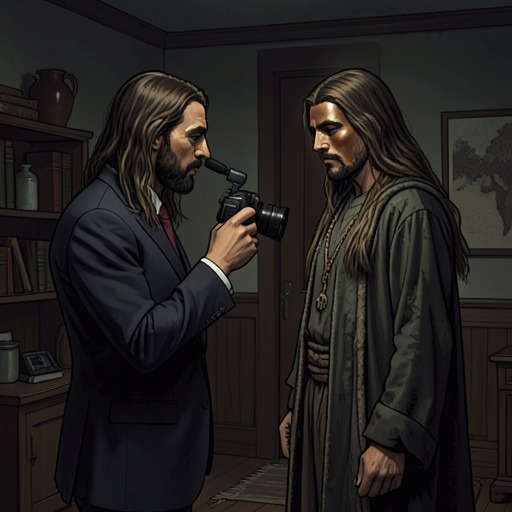
Inside, the narrow stone room resembles a prison cell. At its far end, a rickety desk holds a human skull, leg bones, an antique hourglass, a crystal flask, a candle, two saucers of pale powder, and a sheet of paper; a scythe stands nearby. The carefully arranged objects initially seem to confirm the room’s grim, unsettling character. Langdon identifies the powders as salt and sulfur and recognizes the collection as the familiar furniture of a Chamber of Reflection, a cold, austere place where a Mason contemplates mortality.
Each object belongs to a system of transformation rather than functioning as an isolated curiosity. The skull represents the body’s eventual transformation through decay; salt and sulfur are alchemical catalysts; the hourglass makes time’s transforming power visible; and the candle evokes primordial fire and the awakening from ignorance. The scythe, bones, and hourglass make death present in the room, while the arrangement turns that presence into an occasion for considering how to live. Langdon explains that the chamber’s symbols are meant to prompt reflection on the shortness of life, not to stage a spectacle of death.
The setting nevertheless resists easy reassurance. Sato and Anderson first encounter a skull and bones in a cold, enclosed underground room, and the sulfur’s pungent smell intensifies its unsettling atmosphere. Langdon compares the unfamiliar Masonic images with religious symbols that can also seem disturbing when separated from their traditions. His explanation reframes what the investigators see, but it does not remove the room’s deliberate austerity: the chamber confronts its visitor with death before offering any interpretation of it.
VITRIOL and the Hidden Opening
The meaning of the chamber changes when Sato lights its candle. The flame spreads across the constricted space and reveals seven faded capital letters on the rear wall: VITRIOL. Langdon explains that the word abbreviates a Masonic meditative instruction to visit the interior of the earth and, through rectification, find the hidden stone. The phrase gives the underground setting a symbolic direction. The search into the earth is at once a physical descent and an invitation to seek an obscured source of knowledge.
The hidden stone has several possible meanings in the traditions Langdon describes. It may be associated with the stone pyramid, the Philosopher’s Stone sought by alchemists, the Holy of Holies, or hidden Christian teachings linked to Saint Peter. He does not present one interpretation as settled. Instead, the phrase’s meanings vary across esoteric traditions, although the hidden stone consistently signifies a source of power and enlightenment. In SBB XIII, that ambiguity becomes material: the investigators are not merely reading a maxim but confronting the possibility that a hidden stone is literally nearby.
A flicker in the candlelight makes the rear surface seem to ripple. Langdon realizes that it is not a solid wall but a canvas that has billowed back through the plane of the wall. When he pulls the fabric aside, the investigators see a square opening, roughly three feet across, cut through the brickwork. It extends only a few feet into the wall, forming a recessed niche rather than a passage into another room. A nine-inch carved granite pyramid, polished on four sides, sits inside it. The discovery resolves the immediate visual puzzle of the room while opening a larger one: the small pyramid is present, but its purpose and the secret associated with it remain to be understood.
Secrecy and Narrative Significance
SBB XIII brings together two kinds of concealment. The first is administrative and spatial: a private designation, missing keys, a closed door, and an otherwise abandoned row place the room outside ordinary circulation. The second is symbolic: the Chamber of Reflection makes its objects legible only through knowledge of Masonic practice, and its rear inscription turns the literal descent underground into an interpretive task. Langdon’s earlier explanation that Freemasonry is a society with secrets, rather than simply a secret society, offers a useful distinction here. The hidden room does not by itself prove the broader suspicions directed at the Masons; its contents instead belong to a particular system of ritual symbols and guarded knowledge.
The room also complicates the boundary between public authority and private belief. It exists beneath the Capitol, a working government building, yet its record assigns it to Peter, and its contents suggest a space for inward contemplation rather than public business. Langdon speculates that Peter may have created a sanctuary for Masonic brothers working in the building, where a powerful official could reflect before making consequential decisions. He does not know whether that is the room’s actual history. What the scene establishes is the possibility of such a refuge and the tension between the reflective purpose Langdon describes and the urgency with which Sato’s investigation demands entry.
As a plot location, SBB XIII turns a chain of clues into a physical revelation. The matching markings, the exception in the storage records, the death imagery, the inscription, and the canvas wall each revise the investigators’ understanding of what lies below the Capitol. The final discovery does not simply reward the descent with an object; it makes the room itself part of the cipher. Mortality, secrecy, and the search for hidden wisdom occupy the same confined space, while the small pyramid behind the wall points beyond it to a mystery that the room reveals but does not solve.